
Sleep apnea and mortality: how nighttime breathing issues impact your lifespan
“Even when I sleep, I feel more tired afterward?” “Ever been startled because the person next to you seemed to stop breathing?” If so, never dismiss these signs. They may not just be quirky “sleep habits,” but a pathological condition directly linked to survival:
This could be Sleep Apnea.
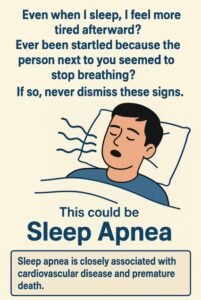
📌 Sleep apnea is closely associated with cardiovascular disease and premature death.
What is Sleep Apnea?
Sleep apnea refers to a condition where breathing temporarily stops or significantly decreases during sleep. When this occurs more than 5 times per hour, with each episode lasting over 10 seconds, it is considered pathological. There are two main types:
- ◉ Obstructive Sleep Apnea (OSA)
→ Occurs when soft tissues around the airway collapse and block airflow - ◉ Central Sleep Apnea (CSA)
→ Caused by the brain failing to send proper signals to control breathing
These breathing disturbances do not simply cause fatigue. They lower blood oxygen saturation, repeatedly awaken the brain, and impair self-repair mechanisms—disrupting the balance of the entire body.
What do studies say about sleep apnea and mortality?
There is a growing body of research linking sleep apnea with all-cause and cardiovascular mortality. Long-term follow-up studies across various populations have confirmed statistically significant correlations.
Notable recent studies:
- 🔎 U.S. National Heart, Lung, and Blood Institute (NHLBI)-sponsored study (2009)
Over 1,400 subjects followed for 15 years
In the severe sleep apnea group (AHI ≥ 30):
→ All-cause mortality was 3.2 times higher
Particularly elevated risk in men, individuals aged 60+, and those with obesity - 🔎 Toronto Sleep Center analysis, Canada (2014)
Among untreated patients:
→ Cardiovascular mortality increased 4.9 times
In contrast, patients treated with CPAP showed significantly reduced risk - 🔎 Seoul National University Hospital Sleep Center (2023)
Analysis of over 2,000 patients
In those with AHI ≥ 15:
→ Cerebrovascular mortality increased 2.8 times within 10 years - 🔎 European Sleep Research Society meta-analysis (2025)
Integrated results from over 30 studies
Total sample: 400,000 individuals
Among patients with moderate to severe apnea:
→ Mortality rate increased by an average of 3.4 times
Summary Table: AHI and Mortality Risk (as of 2025)
| Apnea-Hypopnea Index (AHI) | Stage | Mortality Risk Increase |
|---|---|---|
| 0–4 | Normal | Baseline |
| 5–14 | Mild | 1.2–1.6× |
| 15–29 | Moderate | 2.4–2.9× |
| ≥30 | Severe Risk Group | 3.5–5.0× |
Why does sleep apnea increase mortality? 5 underlying mechanisms
It’s not just about “not breathing.” The core problem lies in repeated oxygen deprivation and autonomic nervous system disruption during sleep, which can trigger a wide range of conditions.
🔍 Here are the major physiological mechanisms by which sleep apnea raises mortality risk:
- Oxygen deprivation → Cellular damage
• Brain and heart muscle cells are extremely sensitive to oxygen levels
• Repeated hypoxia leads to cumulative micro-damage
• Consequences: cognitive decline, arrhythmias, increased risk of myocardial infarction - Autonomic nervous system imbalance (sympathetic overdrive)
• Excessive increases in blood pressure and heart rate during sleep
• Linked to hypertension, angina, and sudden cardiac death - Cheyne-Stokes respiration
• Alternating rapid breathing and pauses
• Common in heart failure patients
• Mortality rate exceeds 45% (JAMA, 2010) - Metabolic dysregulation
• Increases insulin resistance
• Leads to hyperlipidemia and hyperglycemia
• Heightens risk for diabetic complications and vascular disease - Hemodynamic instability → Stroke risk
• Prolonged apnea destabilizes cerebral blood flow
• Increases frequency of ischemic strokes and transient ischemic attacks (TIAs)
How is it diagnosed? What to do if you suspect it?
Sleep apnea is difficult for patients to recognize themselves. Thus, observation by family members or partners often becomes the first clue.
If you notice these symptoms, testing is essential:
- Loud or frequent snoring
- Fragmented sleep
- Daytime sleepiness for no apparent reason
- Morning headaches or dry mouth
- Sensation of choking or gasping during the night
✅ Definitive diagnosis: Polysomnography (PSG)
Conducted in a hospital sleep lab; measures brain waves, oxygen saturation, breathing patterns, etc.
AHI ≥ 15: treatment is essential!
Treatment and Management: A choice that changes survival
📌 Among various treatment options, consistency with the method that suits you best is key.
- CPAP (Continuous Positive Airway Pressure)
→ Delivers air into the airway to prevent collapse
→ Reduces cardiovascular mortality by over 50%
→ Lowers drowsy-driving accidents by nearly 70% - MAD (Mandibular Advancement Device)
→ Advances the lower jaw to widen the airway
→ Effective for mild to moderate OSA - Weight loss therapy
→ 5–10% weight reduction lowers AHI by over 20%
→ Particularly effective if abdominal obesity is a key factor - Nasal structure corrective surgery
→ Helpful for anatomical issues like nasal blockage or enlarged tonsils
Lifestyle improvements: Non-negotiable practices
- Increase CPAP usage time
• At least 4 hours per night; consistency is crucial - Lose weight
• Reducing abdominal fat relieves airway compression - Limit alcohol and smoking
• These inflame and swell airway tissues, worsening apnea - Keep a consistent bedtime
• Supports recovery of circadian rhythm - Undergo sleep testing every 1–2 years
• Especially important for those over 40 or with comorbid hypertension or diabetes
“Breathing sleep” is the foundation of health
Sleep apnea is not just a sleep disorder—
It is a serious medical condition that determines systemic health and mortality. But there’s no need to live in fear.
🔑 Early detection + Accurate diagnosis + Consistent treatment
These three pillars can not only mitigate the risk but actually extend your healthy lifespan.
CPAP isn’t just a machine—it’s your life-saving breathing assistant.
Reclaim your sleep—not the kind where you stop breathing, but the kind that breathes life into you.
📚 References
- Punjabi NM, “Sleep apnea and cardiovascular disease: epidemiology and pathophysiology.” Sleep, 2009.
- Sahlman J. et al. “Impact of untreated OSA on mortality.” Chest, 2014.
- Seoul National University Hospital Sleep Center Clinical Data Report, 2023
- European Sleep Research Society. “OSA and mortality risk meta-analysis.” 2025
- JAMA, “Cheyne-Stokes Respiration and Sudden Death,” 2010